WW3 begins — Information War
Third World War Begins as a Cyber and Information Conflict

A major interstate conflict begins primarily through cyber, information and infrastructure attacks rather than immediate mass conventional war.
GALSOV
lore.galsov.com / Timeline
Terran Historical Archive
From the information wars of Old Earth to humanity's Second Golden Age — a chronological record of survival, expansion, fracture and reconstruction.
What's new
Historical era
c.2205–2210
WW3 begins — Information War
A major interstate conflict begins primarily through cyber, information and infrastructure attacks rather than immediate mass conventional war.
Data-centre raid and hot escalation
A bounded physical raid on a facility associated with hostile cyber/information activity becomes the bridge from information conflict to conventional war.
WW3 conventional phase
WW3 expands into a large conventional conflict while remaining short of nuclear use.
Town Torn in Two ceasefire
A humanitarian evacuation in a border town becomes the emotional turning point that exposes how exhausted the combatants have become.
WW3 peace
WW3 ends through mutual exhaustion and a deliberately non-punitive settlement.
Historical era
2210–2280
Difficult Peace and reconstruction surge
Former enemies rebuild infrastructure and institutions while cooperation remains unusually intense.
Post-WW3 institutional reforms
Governments respond to the information-war experience with stronger truth, media, labour, environmental and corporate protections.
The Good Decades
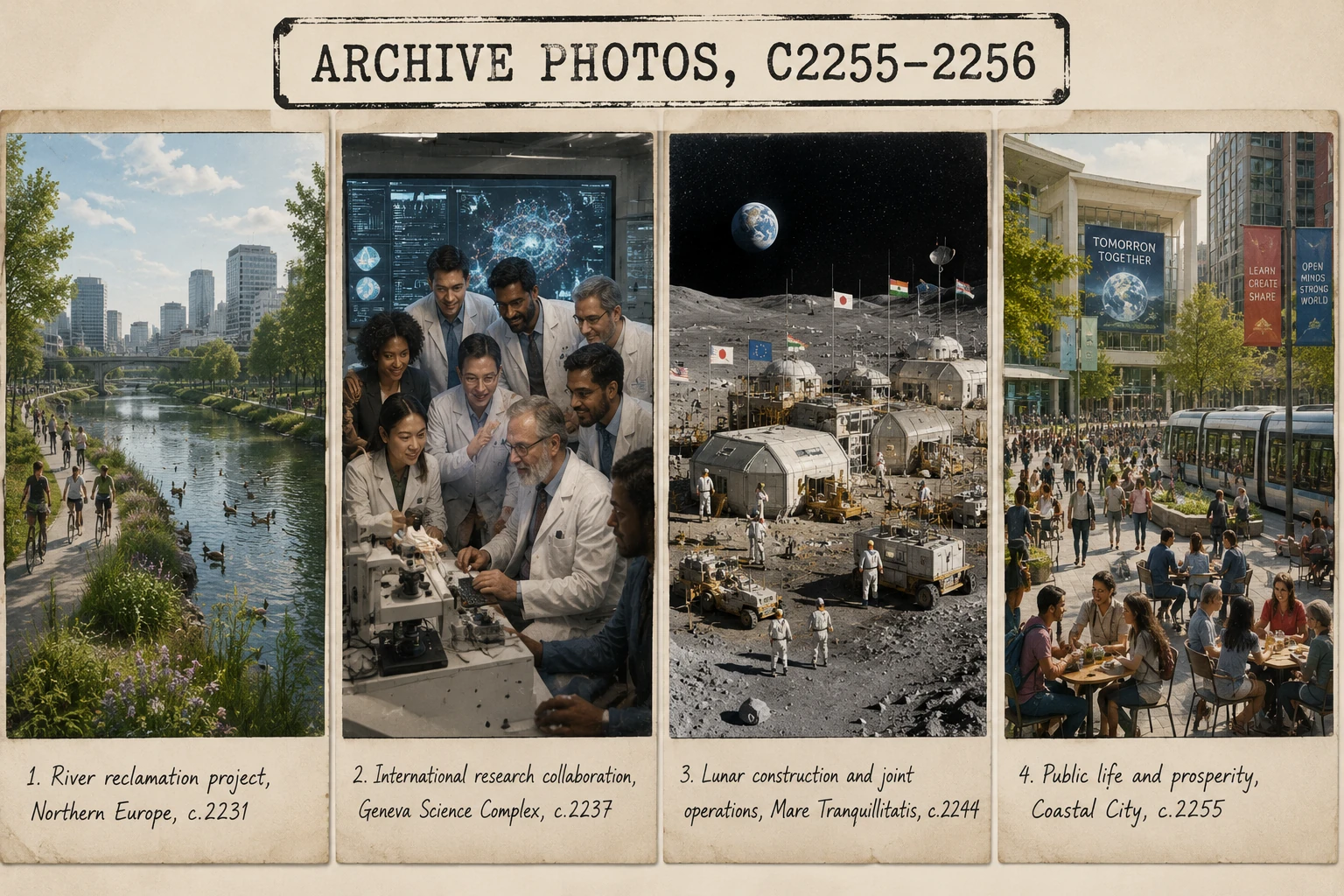
A genuine period of broad prosperity, reconstruction and confidence follows WW3.
Moon growth and constructive space race
Earth powers expand lunar science and settlement during the Good Decades.
Normality / 'Meh' years
Prosperity becomes normal enough that institutional caution gradually weakens.
Historical era
2280–2304
Long Resource Squeeze
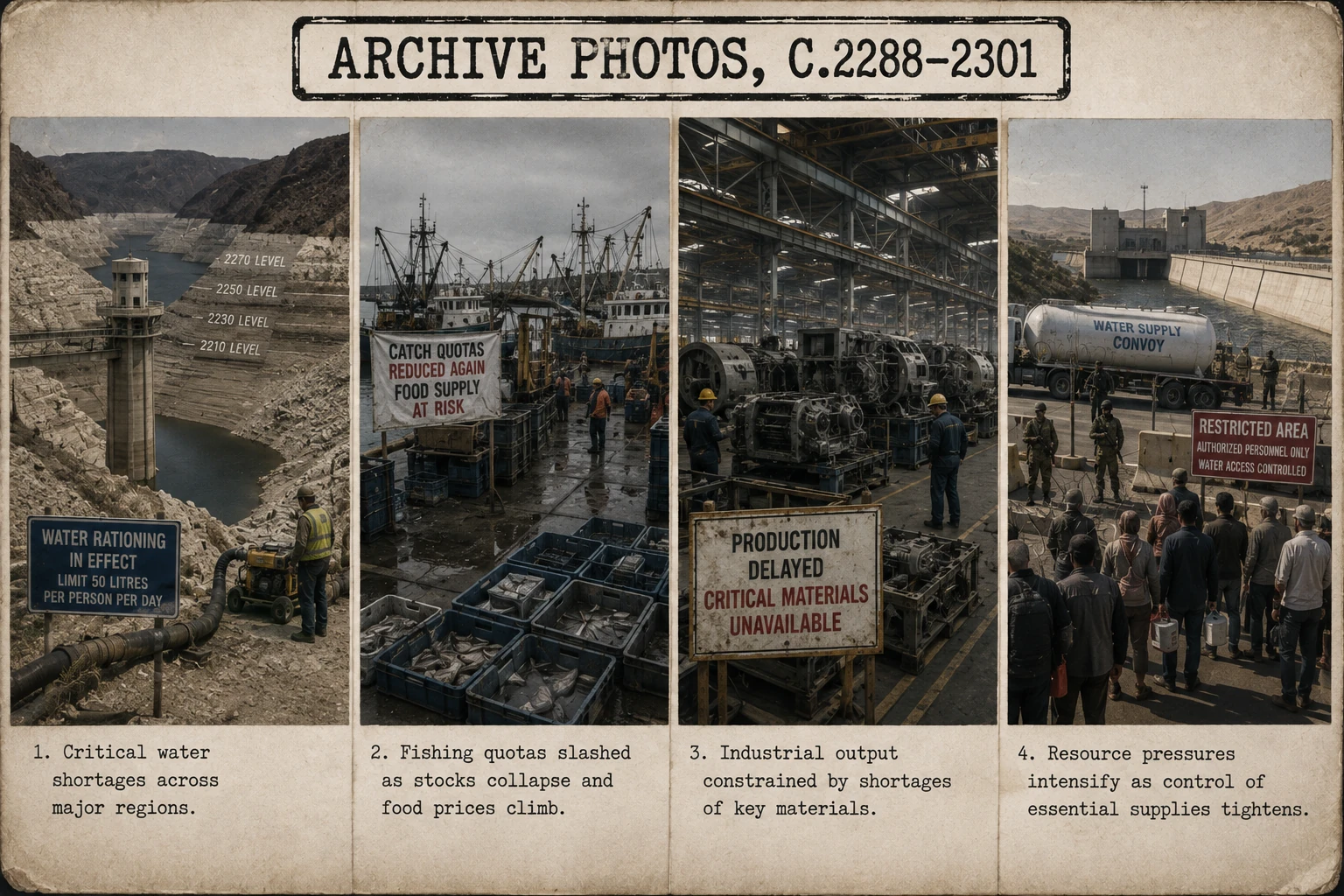
Resource, pollution, water, food and industrial pressures accumulate over decades.
Resource-border and environmental clashes
Fishing, river, water and resource disputes turn the Long Resource Squeeze into recurring limited conflicts.
Historical era
2304–2319+
WW4 — The Fracture
A twelve-year polycentric world war erupts as a web of overlapping wars, coups, civil conflicts and shifting alliances.
WW4 technology acceleration
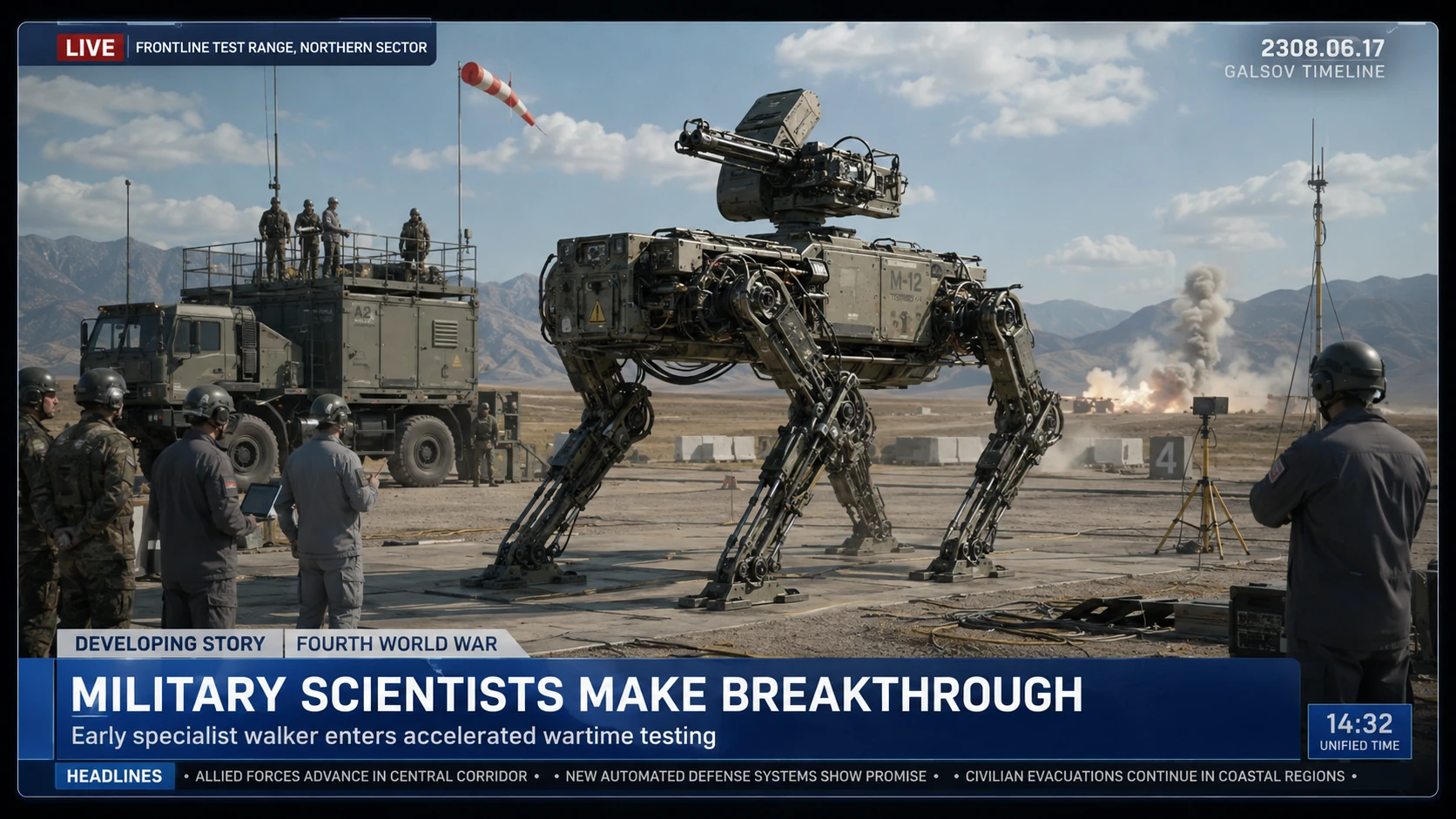
The Fracture drives another major leap in fusion, aerospace, automation, sensors, medicine, rapid manufacturing and specialist war machines.
Lunar abandonment and de facto autonomy
Earth's war fragments support to lunar settlements, forcing them to cooperate locally and operate with increasing autonomy.
Paris impact — first city destroyed
A city is destroyed in an apparent strategic strike just as one major combatant is close to launching fusion weapons.
Beijing impact — second city destroyed
A second city on an unrelated/opposing side is destroyed, again without a matching fusion-launch signature.
Burning Sky / immense near miss
A huge high-altitude fireball or close-passing object is seen widely and later calculated to have been enormously destructive if it had struck.
Asteroid stream identified
Scientists correlate meteor activity, impacts and fragmented sensor data and discover a much larger incoming natural stream.
Great Turning planetary-defence campaign
Humanity mounts an emergency multinational defence effort against the asteroid stream; the immediate extinction-risk window lasts roughly four to six weeks, followed by months of additional interception, deflection and monitoring.
The Fracture loses its emotional momentum
The asteroid crisis effectively ends the willingness of most soldiers and civilians to continue the war.
Diplomatic unwinding of the Fracture
Military fighting stops before a neat single peace treaty exists.
More than one billion dead
Combined WW4 and impact losses exceed one billion people while civilisation remains technologically intact enough to rebuild.
International Planetary Defence Committee (IPDC) formed
A permanent equal-representation multinational body emerges from Great Turning cooperation.
Solar Survey Agency (SSA) created
The IPDC establishes a semi-autonomous operational/scientific arm to run increasingly comprehensive Solar observation.
SatNet begins
Dedicated planetary-defence and observation satellites evolve into a vast Solar monitoring network.
Rapid demobilisation and industrial conversion
Huge wartime forces and suppliers are redirected toward rebuilding, infrastructure and space/planetary-defence work.
Historical era
2317–c.2400
Long Reconstruction
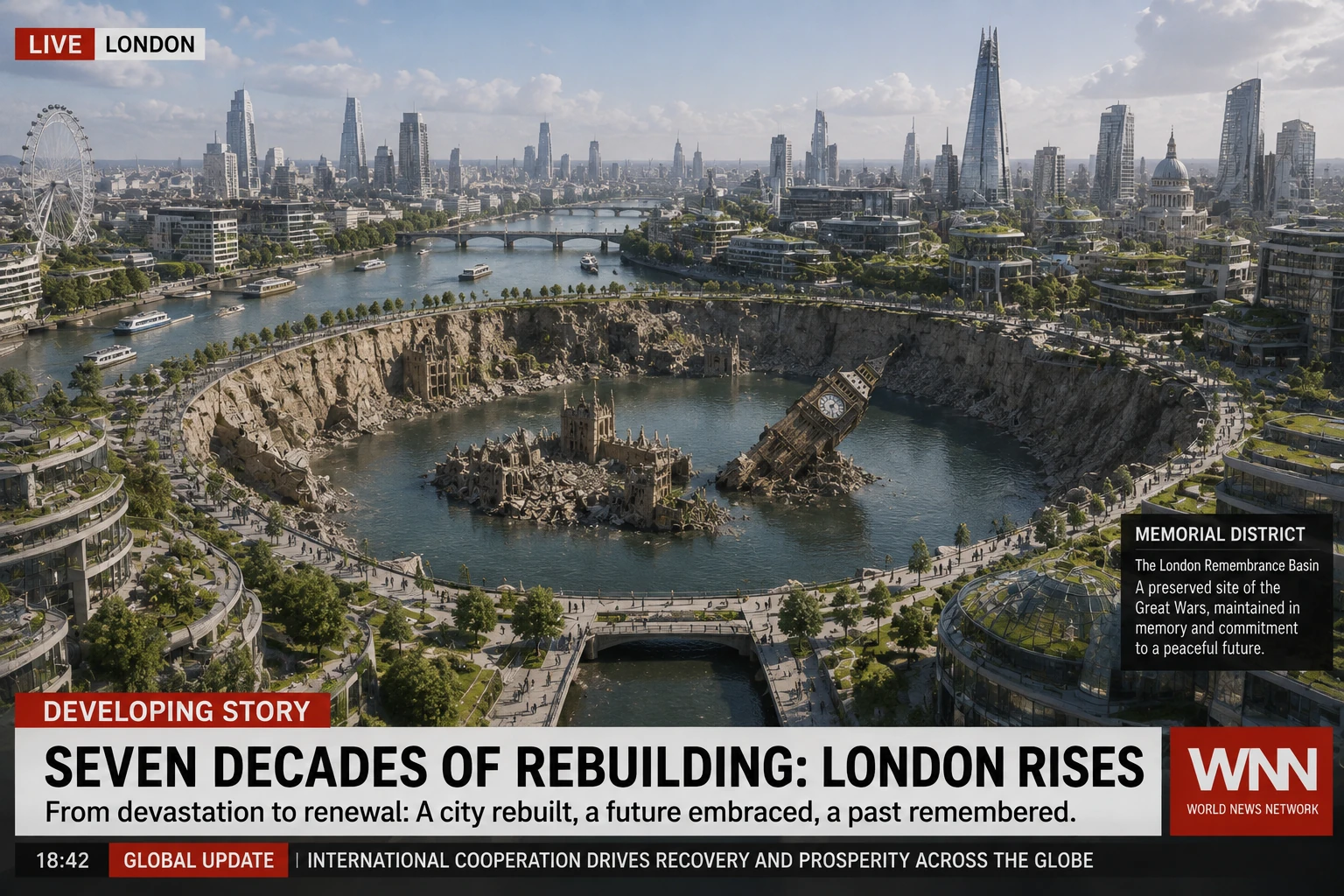
A reconstruction period lasting at least fifty years repairs cities, states, ecosystems and political legitimacy.
Human Federation emerges
The Federation forms gradually from successful shared institutions rather than from a single utopian constitutional moment.
Luna becomes the first independent Federation colony
Existing lunar settlements are ratified as a self-governing Federation colony rather than possessions of founding Earth states.
Mars colony programme begins
Mars becomes the first deliberately founded planetary Federation colony.
Mars terraforming begins as a Day-One objective
Terraforming is embedded in the Mars project from the first automated arrivals.
Historical era
c.2400–2538
Mature Federation social settlement

The Federation's humane social and political model matures over generations.
Asteroid resource economy
SSA asteroid study evolves into commercial extraction and in-space resource use.
Earth orbital yards expand
Earth becomes the first major centre of large-scale orbital construction and interplanetary shipbuilding.
First major Starbase becomes a trade/transshipment hub
A large orbital station around Luna becomes the commercial heart of early interplanetary trade.
Sol Trade Circuit
A flexible commercial network links Earth, Luna, Mars, the Belt and later outer-system hubs.
The Fifteen launch campaign
The Federation/SSA launches fifteen autonomous interstellar survey probes toward shortlisted nearby systems.
The Fifteen reports begin returning
Direct reports from the nearest probes arrive after decades of travel plus light-speed communications delay.
Historical era
2538–2645
Alpha Centauri selected for first extrasolar colony
Alpha is chosen because it is the best first mission, not necessarily the objectively best planet.
Alpha Centauri colony launch programme
The Federation begins the first extrasolar colony programme only two years after receiving the actionable Alpha report.
First human arrival at Alpha Centauri
The first human colony wave reaches Alpha Centauri and begins permanent extrasolar settlement.
Alpha safety doctrine is exercised
The oversized support/evacuation capability is actually used at least once rather than remaining theoretical.
Annual frontier migration begins
Established colonies receive regular migration/supply ships based on what they can safely absorb.
First alien archaeology discovered on Alpha
Automated subsurface mineral 'worms' accidentally encounter worked structures beneath an ordinary-looking site.
Commercial Helium-3 breakthrough
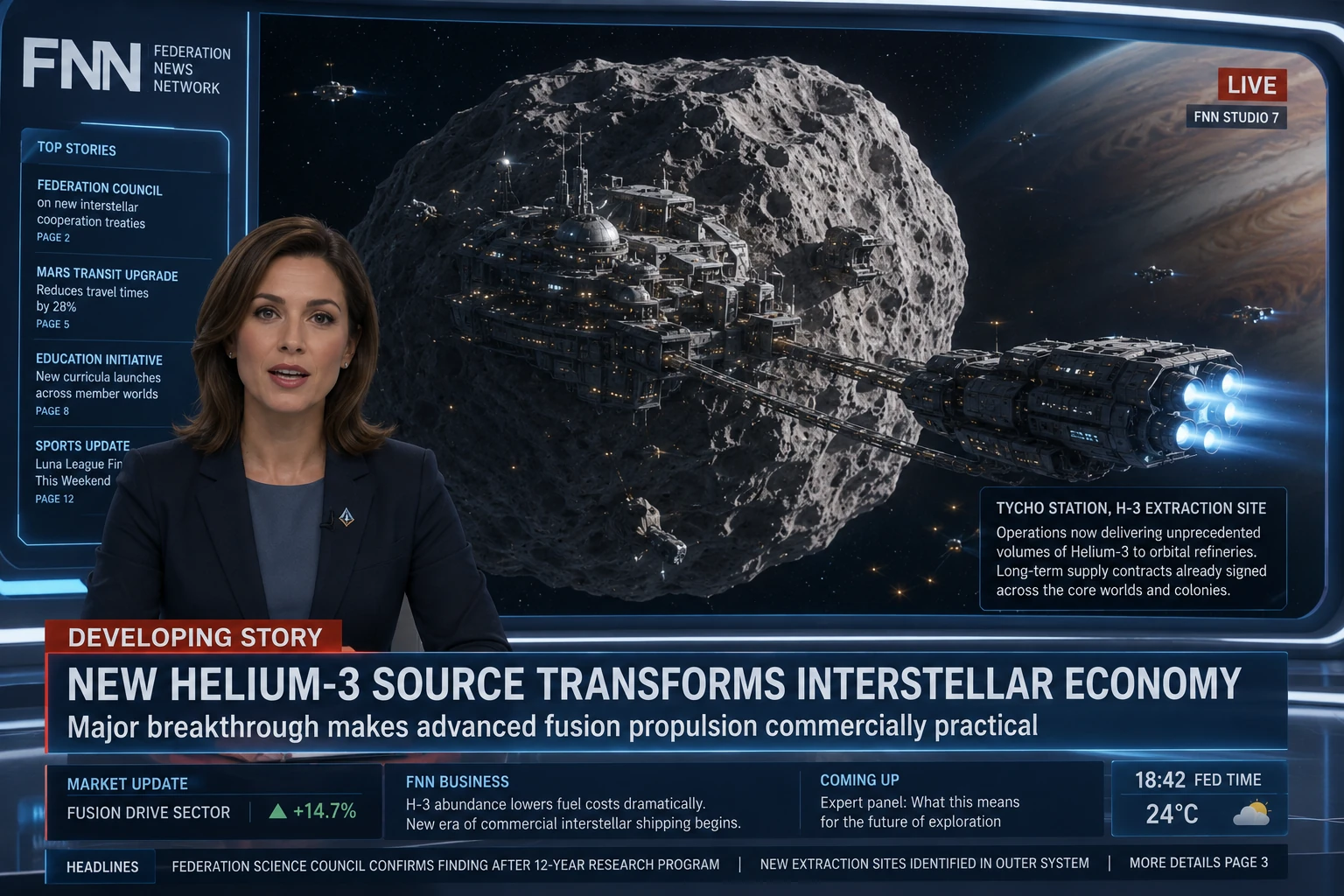
Alpha Centauri provides the first exceptionally practical large-scale Helium-3 source, removing a major economic/fuel constraint from mature fusion propulsion.
He-3 propulsion/logistics revolution
Abundant fuel combines with mature engineering to push interstellar travel from early colony speeds toward high-performance fast-sublight travel.
First Interstellar Golden Age
Exploration, discovery, investment, technology and settlement reinforce one another into a genuine Golden Age.
Exploration opens; colonisation remains Federation-approved
Independent and sponsored ventures can travel, survey and prospect freely within law, while permanent civilian colonies require Federation approval.
Outpost Ships spread through the frontier
Large mobile industrial settlements become the core of mining, refining, logistics and remote economic expansion.
First successful Translight information transmission
Humanity sends information faster than light for the first time; matter still cannot be transported by the effect.
Practical Translight communications become operational
Translight moves from breakthrough to dependable communications infrastructure.
Historical era
2645–2990
Deep Survey Programme begins
Long-range probes are fired far beyond the settled bubble along an inward corridor roughly toward the Galactic Centre.
Far-Distance mission already in planning
The Far-Distance experiment is the long-term objective that caused the Mid-Distance proof stage to exist.
Nearby colony network becomes established
Humanity reaches roughly half a dozen well-established extrasolar colonies, several newer ones and one or two additional colony efforts underway.
Actionable Mid-Distance survey report received
The Federation receives a sufficiently complete survey of a viable system roughly 20 light-years from Sol.
Mid-Distance staged expedition launches
A staged Alpha-like sequence departs with personnel drawn from the entire Federation rather than mainly Earth.
Mid-Distance self-sufficiency doctrine
The colony arrives designed to function independently from Day One.
First Mid-Distance settlement established
Humanity establishes its first deliberate colony roughly 20 light-years from Sol.
Actionable Far-Distance survey report received
The Federation receives a viable survey for a deliberately much more distant colony target, roughly 45 light-years from Sol.
Far-Distance Colony Expedition launches
Humanity launches the final major proof colony before committing the Great Ark.
Great Ark programme
Humanity begins planning a single civilisation-scale colony mission far beyond the normal support network.
Far-Distance settlement established
The Far-Distance expedition reaches and establishes its target colony after a roughly 130-year crossing.
Historical era
2990–3238
Far-Distance proof clears the Great Ark final gate
Fifteen years of successful Far-Distance operation provide enough evidence to approve final Great Ark construction and launch.
The Ark is built from proven technology
The Great Ark scales and integrates technologies already demonstrated elsewhere rather than relying on multiple untested miracles.
Great Ark departs
The most ambitious human colonisation mission yet leaves a prosperous, optimistic civilisation for a centuries-scale sublight journey.
Great Ark mission baseline
The Ark is designed for a roughly 175-light-year sublight mission using the finest proven propulsion available at launch.
Ark population remains in cryostasis
Essentially the whole human population spends the early/majority portion of the journey in advanced induced torpor.
Star Magic — first matter-FTL event
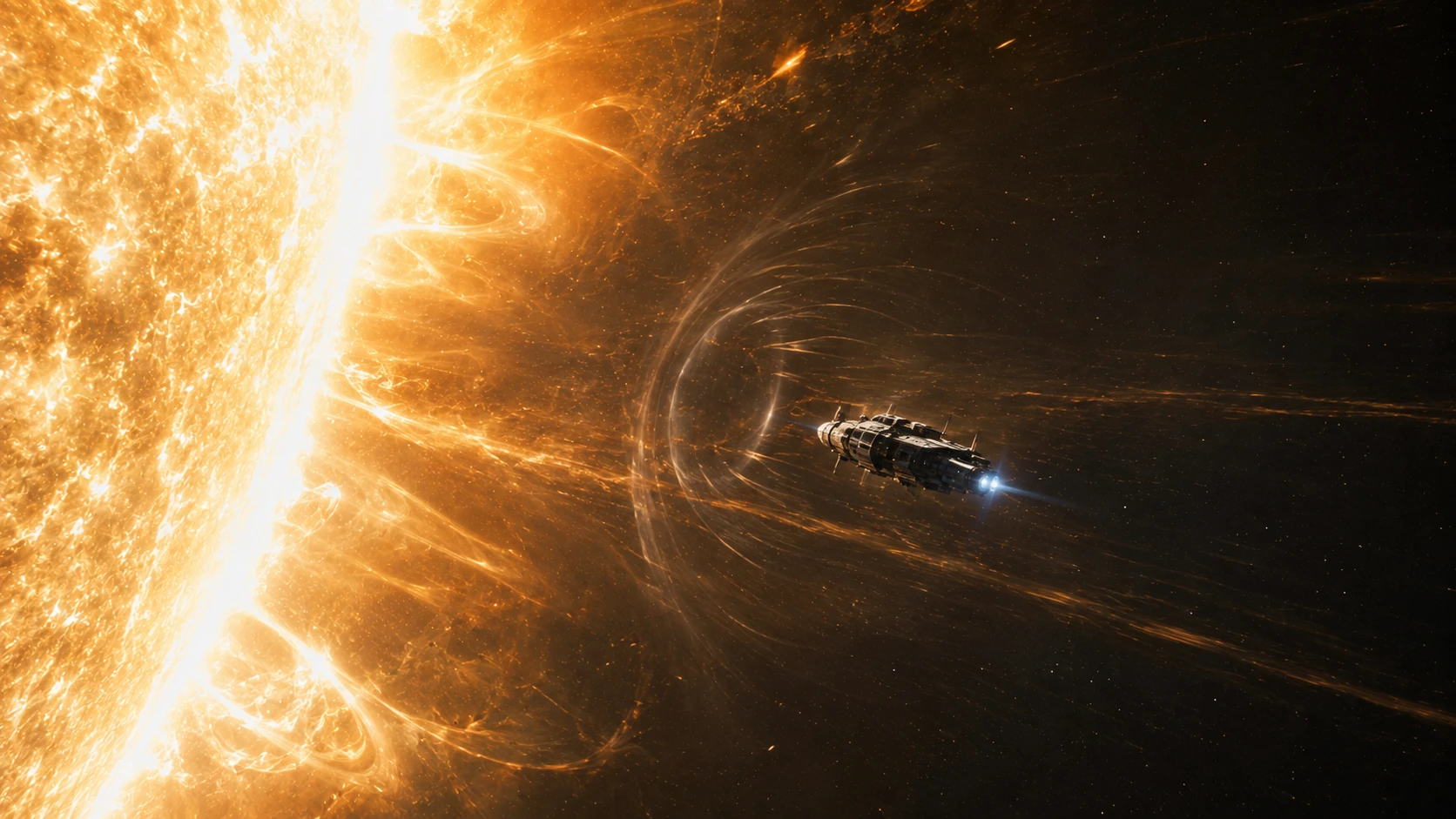
A matter-jump experiment unexpectedly sends a craft across an interstellar distance, proving that the Translight phenomenon can affect matter.
First deliberate controlled matter jump
Researchers reproduce the Star Magic effect deliberately under controlled conditions.
Practical prototype SJD demonstrated
A practical prototype Star Jump Drive demonstrates controlled star-linked matter-jump travel.
First complete SJD engineering package reaches the Great Ark
The Ark receives the first complete buildable package for practical SJD through Translight communications.
SJD refinements continue reaching the Ark
The travelling Ark remains connected to human scientific progress by Translight even though it cannot retrofit the drive safely.
Historical era
3238–DR40
The Big Miss
The Great Ark encounters an unanticipated spacetime anomaly while almost the entire population remains asleep.
Lost-time problem
No trustworthy continuous high-level chronology survives the anomaly.
AI cannot fulfil primary destination directive
The Ark AI discovers that designated destination X, Sol and the expected stellar map cannot be reconciled with its current observations.
AI balances habitability against recoverability
The AI searches outward incrementally rather than travelling indefinitely toward the objectively best world it can imagine.
Sub-par but viable world selected
The Ark identifies a world that is difficult rather than horrific: good enough to support a colony, but clearly worse than the mission's intended destination.
First humans wake after the Big Miss
A command/scientific/engineering cohort wakes to an AI briefing that the planned route is impossible, losses are real and a viable alternative world has been found.
Post-Miss human casualty assessment
The surviving crew confirm that roughly 4% of the Ark's human population has died.
Embryo reserve losses confirmed
Roughly 25% of the Ark's stored embryo reserve is lost or rendered non-viable.
Ark equipment and cargo losses assessed
The Ark has lost roughly 15–20% of colony equipment outright and another roughly 10–15% is damaged or initially unusable.
Settlement world conditions confirmed
The chosen world is cold and strongly seasonal but fundamentally habitable.
Landfall and Ark cannibalisation
The stranded colonists begin settlement using a damaged but extraordinary inheritance of technology and expertise.
Emergency colony years
The first decade is defined by survival, repair, local production and repeated use of emergency powers.
Extended cryostasis precedent
A serious resource shortfall may force leadership to keep part of the planned population asleep longer than intended.
Survival secured; reconstruction continues
The colony is clearly going to survive, but it remains materially poorer and less capable than the Ark plan intended.
Historical era
DR28–165
First major industrial/frontier settlement established
The colony establishes its first major secondary industrial/frontier settlement after a public argument between two or more credible expansion options.
Generational reinterpretation of the Federation
Children and grandchildren inherit the founders' emergency compromises but increasingly disagree about what those compromises proved.
Rules-versus-Ideals divide becomes a clear political fault line
Two coherent political traditions are now recognisable across elections, courts and constitutional arguments.
Historical era
DR165–275
Second Fracture
After decades of recognisable Rules-versus-Ideals division, the colony formally separates into two sovereign successor states without an immediate civil war.
Friendly pragmatic separation
The two states begin with surprisingly workable relations rather than an immediate Cold War.
First major Family Crossing Crisis
A citizen crosses to rejoin family in the neighbouring state and the two governments interpret the act through incompatible ideas of freedom and state responsibility.
Semi-regular crossing and asylum disputes
Family reunification, work, marriage, ideology and personal preference continue to move people in both directions, periodically creating political crises.
Border hardening through reciprocal precautions
Administrative controls added after repeated crossing disputes gradually become hardened security infrastructure.
Border becomes visibly militarised
An ordinary observer can now recognise the frontier as a defensive position rather than merely an administrative boundary.
Border Resource / Mine Crisis
A major mine/resource operation located directly on the border creates a security crisis because ordinary industrial activity cannot be cleanly separated by the political boundary.
Historical era
DR275–366
Orbital Security Competition begins
Major new satellite, lunar and orbital infrastructure by one state triggers a deliberate parity programme by the other.
Parity and inspection politics
Both states increasingly demand transparency, inspection, limits or matching capability for strategically ambiguous space systems.
Emergency Intercept Crisis
A short-notice launch against a dangerous asteroid is briefly mistaken by the rival state for a possible strategic attack.
Lunar Facility Disaster / Transparency Crisis
A serious lunar accident exposes the military usefulness of infrastructure that had been described primarily as civilian.
Armed Craft Defection Crisis
A pilot or small crew crosses in a modern armed fighter/interceptor and requests asylum.
High-Tension Sortie Era
Armed air/space interceptors repeatedly shadow, sensor-lock and manoeuvre aggressively around disputed zones without firing.
Fatal Interception Accident
One long-normalised no-fire confrontation ends with a craft lost and its crew killed even though nobody launches a weapon.
Post-crash escalation
The bereaved state applies stronger pressure rather than treating the fatal encounter as an ordinary accident.
Historical era
DR366–385
First live-fire engagement; Great War begins
A subsequent confrontation crosses the threshold from ritualised armed brinkmanship into actual combat.
The Great War
The two successor states fight a roughly nineteen-year ideological and strategic war that transforms the civilisation.
Rapid escalation and warbot/mech return
Existing security forces, dual-use industry and contingency plans rapidly become full wartime systems; specialist warbots/mechs return.
Eventual victor recognises a losing trajectory
The more interventionist/ideals-first state concludes that continuing conventionally will probably end in defeat.
First effective flash-teaching breakthrough
A major accelerated-learning breakthrough dramatically reduces the time needed to train skilled personnel.
Scaled wartime flash-teaching deployment
Flash teaching moves from controlled success to mass wartime use across military and critical technical roles.
First successful adult/somatic enhancement trials
Researchers begin biologically enhancing existing adults to improve wartime performance and response to accelerated training.
Heritable/germline optimisation programme begins
The wartime state begins introducing heritable variants intended to make future generations especially compatible with its training and social systems.
Biology, education and the victorious social model reinforce one another
The genetic programme increasingly interacts with flash teaching, structured education, wartime institutions and real-world success.
Strategic decline halted
The eventual victor's front broadly stabilises after years of loss.
First major sustained counteroffensive succeeds
A sustained offensive demonstrates that the new training, enhancement, industrial and doctrinal system can do more than merely hold the line.
War's strategic direction becomes clearly reversed
Both governments increasingly recognise that the state once expected to lose now holds the strategic initiative.
Decisive central surrender
The Rules state surrenders as a functioning sovereign power and the Great War ends after roughly nineteen years.
Historical era
DR385–405
Post-War Leadership Hearings
The victorious government conducts formal post-war hearings focused primarily on whether the principal defeated leaders will accept reunification and cease acting as an organised restoration leadership.
Principal defeated leaders executed
The principal defeated Rules-state leaders are executed after the post-war hearings because the victorious government judges their continued role as an organised restoration leadership to be an unacceptable future security risk.
Reintegration and Reconstruction Era
The victor punishes the defeated leadership but deliberately seeks to reintegrate the general population rather than criminalise it.
Routine state-directed germline manipulation largely ends
The victorious state stops launching new routine population-wide germline programmes once the immediate wartime/post-war emergency has passed.
Second Golden Age begins — end of first-pass timeline
Reconstruction and reintegration have succeeded well enough that the unified civilisation enters a genuine new era of peace, prosperity, confidence and outward-looking ambition.
End of current reviewed chronology